Software
Inventory Management System in Pakistan: How It Works
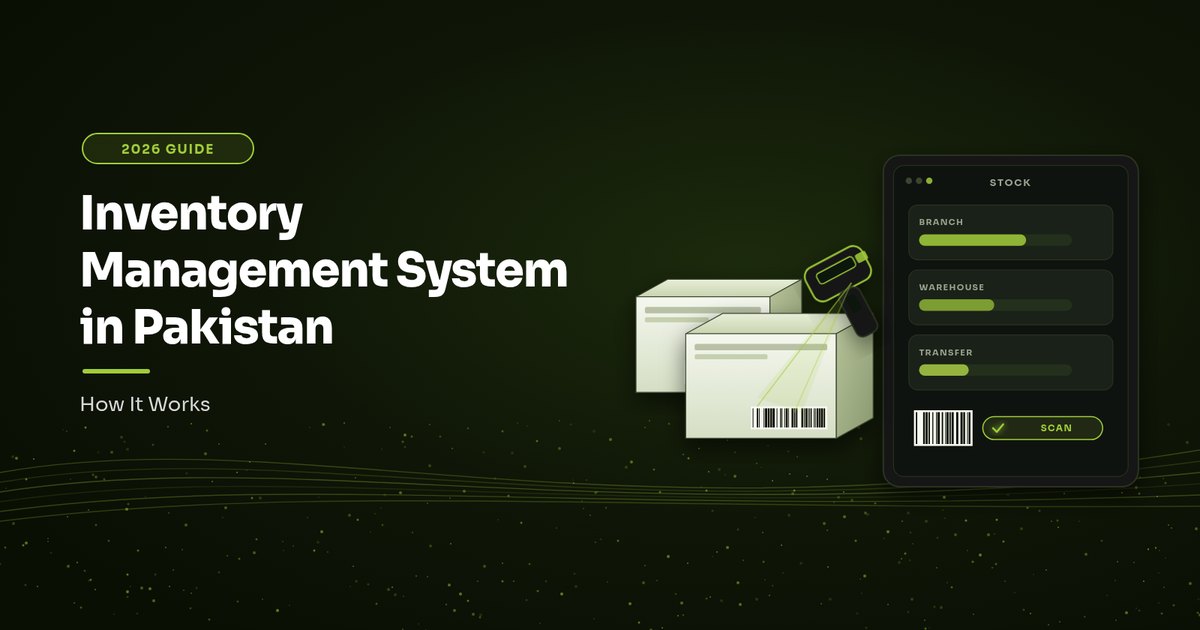
Ask any trader, distributor or online seller what keeps them up at night, and stock usually comes near the top. Items run out without warning, dead stock fills the shelves, and an order gets confirmed online for a product that is no longer there. Registers and spreadsheets work up to a point, then they stop keeping up.
This guide explains what an inventory management system is, how it works day to day, and what to plan for when building an inventory management system in Pakistan.
What is an inventory management system?
An inventory management system is software that records every item you buy, store, move and sell, so you always know what you have, where it is and what it is worth.
At its simplest, it keeps a running balance for each product. A good system also records why the balance changed: a purchase, a sale, a return, a transfer between branches, damage or an adjustment after a count. That history turns a stock number into something you can trust and audit.
Inventory management vs warehouse management
People often search for the difference between an inventory management system and a warehouse management system (WMS).
- Inventory management answers “how much do we have, and where?” across shops, branches and warehouses.
- Warehouse management goes deeper inside one warehouse: receiving, put-away, bin and shelf locations, picking, packing and dispatch.
A small business usually needs the first. A business running a large store room, a distribution centre or online order fulfilment often needs both, working from the same records.
Why it matters now for Pakistani businesses
The way Pakistani customers buy and pay is changing, and stock records have to keep up.
In its Annual Report on Payment Systems for FY26, the State Bank of Pakistan (SBP) reported that the POS network expanded to 337,791 terminals across 295,367 merchant locations. It also reported that account-based online payments made up 96 percent of e-commerce transactions conducted through banking channels.
More card machines and more online checkouts mean more sales happening at once, in more places. If the stock count lives in one person’s register, it cannot keep up with a website, a shop counter and a sales team all selling at the same time.
Policy is moving in the same direction. On 30 May 2026, SAMAA TV reported that the Ministry of Commerce had finalised the draft of Pakistan’s second National E-Commerce Policy. The draft emphasises interoperable digital payments, expanding logistics infrastructure and making cross-border trade easier. A business preparing to sell more widely needs stock data that is accurate across every channel.
How an inventory management system works
Most systems follow the same daily cycle.
- Receiving. Goods arrive against a purchase order. Staff check quantities and, where relevant, batch numbers and expiry dates, then the stock is added.
- Storing. Each item is placed in a known location, such as a branch, warehouse, rack or bin.
- Selling and issuing. Every sale at the counter, online or by a field salesperson reduces stock straight away.
- Transfers. Moving stock between branches is recorded as one transaction, so it never “disappears” in transit.
- Returns and damage. These are logged with a reason rather than quietly adjusted.
- Counting. Regular counts, often a few products at a time, are compared with system balances, and differences are investigated.
- Reordering. When stock falls below a set level, the system alerts the purchasing team or prepares a draft purchase order.
Features of an inventory management system
The right feature list depends on the business, but these come up again and again.
Barcodes and product codes
Barcodes cut typing errors at receiving, counting and sale. GS1, the global standards body for barcodes, says the Global Trade Item Number (GTIN) can be used by a company to uniquely identify all of its trade items. If your products already carry a GTIN barcode, the system can use it. For items without one, it can generate internal codes and print labels.
Multiple branches and warehouses
Each location needs its own balance and its own permissions, with a combined view for owners and managers.
Batches, expiry and serial numbers
Medicines, food and cosmetics need batch and expiry tracking, so stock nearest its expiry date goes out first. Electronics and machinery often need serial numbers for warranty claims. If you run a pharmacy, see our guide to pharmacy software in Pakistan.
Units and pack sizes
Many wholesalers buy in cartons and sell in pieces or dozens. The system should convert between units automatically so balances stay correct.
Valuation and reports
Owners need stock value, slow-moving and dead stock reports, and profit by product. Your accountant should agree the valuation method before go-live.
Roles and audit trail
Not everyone should be able to adjust stock. Every change should record who made it and when.
Connecting stock to sales, accounts and online orders
An inventory system becomes far more useful once it connects to the rest of the business.
- POS and billing. Each sale at the counter should reduce stock instantly. In ERP and POS software, purchases, sales and stock all post to the same ledger.
- Website or online store. For an inventory management system for an e-commerce website, the website should show live availability and reserve stock when an order is placed. If payment fails or the order is cancelled, the reservation is released. Our guide to payment gateway integration explains how payment results should update orders.
- Field and warehouse apps. A mobile app lets salespeople book orders against real stock and lets warehouse staff scan items on the move. It should keep working during short signal drops and sync afterwards.
- Web dashboards. A browser-based web application gives owners one live view across all branches, from anywhere.
The key design rule is one source of truth. Every channel reads from and writes to the same stock records, instead of each keeping its own copy.
Moving from spreadsheets or registers
Many businesses start with Excel, and for a small number of products it can work. Problems appear when several people edit at once, when there is more than one location, or when sales happen online.
When you move to a system:
- Clean the product list first. Remove duplicates and agree on names, codes and units.
- Do a full opening count on the cut-over day, not an estimate.
- Run old and new side by side for a short period at one branch before rolling out everywhere.
- Train the people who receive and sell, because receiving and selling are where stock records are created.
Frequently asked questions
What is an inventory management system, with an example?
It is software that tracks what you buy, store and sell. For example, when a shop sells two cartons, the system reduces the stock balance straight away and alerts purchasing when the item falls below its reorder level.
What is the difference between an inventory management system and a warehouse management system?
Inventory management tracks quantities and value across all locations. A warehouse management system manages work inside a warehouse, such as receiving, shelf locations, picking, packing and dispatch.
Can I use Excel for inventory management?
Yes, for a few products and one location. Once you have several users, branches or online sales, a system with live updates, user permissions and an audit trail is more reliable.
How does an inventory management system with a barcode scanner work?
Each product carries a barcode. Staff scan it when receiving, counting or selling, and the system updates the right product instantly without manual typing.
If you are planning an inventory system for your business, contact Software Craft.
Sources
- Business Recorder, “PRISM+ settles 6.3m transactions: SBP” (7 October 2026), reporting SBP’s Annual Report on Payment Systems FY26: https://www.brecorder.com/news/40443035
- SAMAA TV, “E-commerce policy draft finalised to accelerate access to global market” (30 May 2026): https://www.samaa.tv/2087351249-e-commerce-policy-draft-finalised-to-accelerate-access-to-global-market
- GS1, “Global Trade Item Number (GTIN)”: https://www.gs1.org/standards/id-keys/gtin
Planning a software project?
Tell us what you want to build and our team will suggest the right web, mobile, ERP or AI solution.