Software
Restaurant Management System in Pakistan: 2026 POS Rules
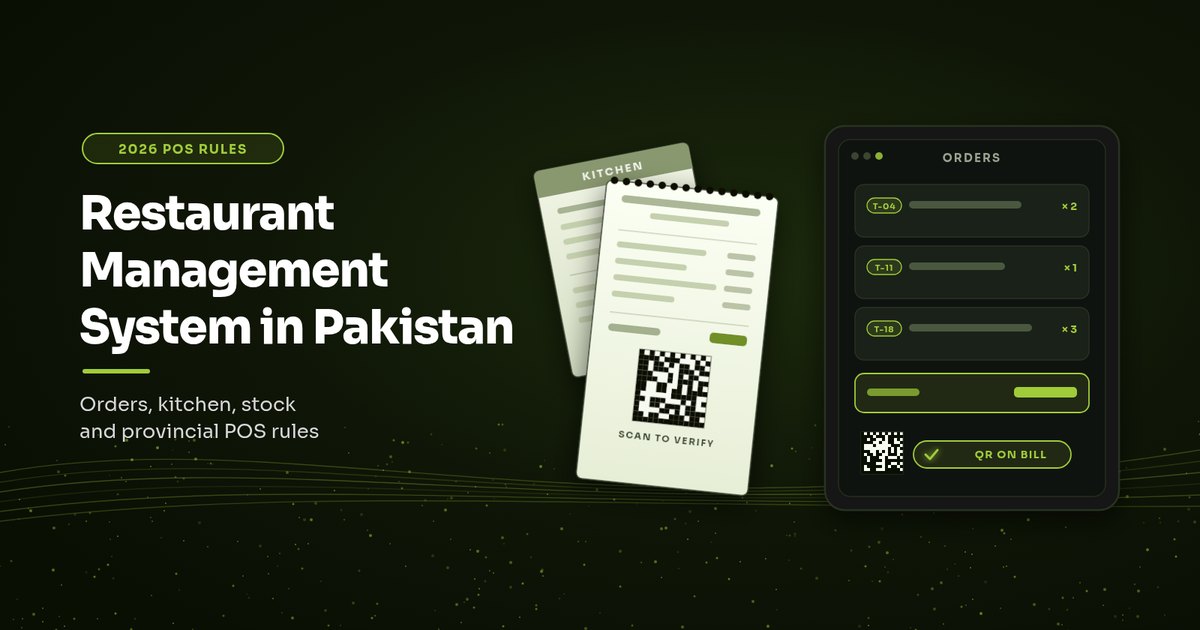
A Pakistani restaurant handles dine-in tables, takeaway, delivery, a busy kitchen and fast-moving stock at the same time. A restaurant management system brings this work into one place. In 2026 it has also become a tax matter: provincial revenue authorities in Punjab, Sindh and Khyber Pakhtunkhwa want restaurant bills reported to them as they are issued, with a QR code customers can check.
This guide explains what a restaurant management system does, the features that matter for a Pakistani restaurant, and how the PRA, SRB and KPRA POS rules shape the software.
What is a restaurant management system?
A restaurant management system is software that runs a restaurant’s daily operations from order to receipt. At the front it takes orders and prints bills. Behind that it sends orders to the kitchen, tracks ingredients and stock, records payments, and reports on sales. Larger setups add branches, a central kitchen, online ordering and an owner app.
Core features a Pakistani restaurant needs
Order taking for dine-in, takeaway and delivery
Dine-in needs table numbers, waiters and split or merged bills. Takeaway needs speed at the counter. Delivery needs the customer’s phone, address and rider. A good system handles all three on one screen.
Kitchen order tickets and kitchen display
Orders should reach the kitchen instantly as a printed kitchen order ticket (KOT) or on a display screen, routed by section so the tandoor and drinks counter each see only their items.
Menu, deals and modifiers
Owners should be able to update prices, add seasonal items, create deals and set modifiers such as “less spicy” without calling a technician.
Recipe-based stock control
The system should know what goes into each dish. When a chicken karahi is sold, the right quantities of chicken, oil and spices are deducted from stock. This exposes wastage and tells the store manager what to reorder.
Payments and the right tax rate
Customers pay by cash, card, mobile wallet or QR, and often split one bill across methods. In Punjab and Sindh the sales tax rate now depends on how the bill is paid (see below), so the system has to apply the correct rate automatically once the payment method is chosen. Restaurants accepting instant digital payments may also want to read our guide to Raast dynamic QR billing.
Works through load-shedding and internet cuts
Billing must continue offline when the connection drops, then sync when the internet returns.
Roles, audit trail and reports
Cashiers, managers and owners need different permissions, and discounts, voids and cancellations should be logged with the user and time. Useful reports cover sales by order type, item-wise profit, peak hours, wastage and branch comparisons.
POS integration with provincial revenue authorities
In Punjab, Sindh and Khyber Pakhtunkhwa, sales tax on restaurant services is collected by provincial authorities, each with its own invoice monitoring system.
Punjab: PRA e-IMS
In August 2026 the Punjab Revenue Authority announced a zero-tolerance policy on Electronic Invoice Monitoring System (e-IMS) enforcement, according to Business Recorder. District notifications then required restaurants, hotels, coffee shops and marriage halls across Punjab to issue receipts through e-IMS, and banned handwritten receipts.
As reported by Dunya News and Daily Times, receipts must carry the business name, address, receipt number and PRA QR code, and kitchen order slips or unpaid bills cannot be handed over in place of a proper receipt. Fines range from Rs 400,000 to Rs 1 million, and repeat violators may be sealed for up to a month.
PRA’s POS user manual, issued in January 2026, says each branch must be registered individually, and integration is tested in a sandbox before going live in production. On tax rates, Geo Fact Check confirmed that from 1 July 2026 Punjab charges 8% on restaurant bills paid by card, mobile wallet or QR, and 16% on cash.
Sindh: SRB POS
The Sindh Revenue Board’s FAQ lists the restaurants that must integrate their POS for live reporting: restaurants in hotels, international franchises, restaurants with more than one branch in Sindh, outlets in air-conditioned malls, restaurants selling through an online marketplace platform, and restaurants whose turnover in the preceding twelve tax periods exceeded Rs 5 million. Those categories were restated in SRB notification SRB-3-4/44/2025.
SRB charges 15% on restaurant services, reduced to 8% when the customer pays by debit or credit card, mobile wallet or QR. Integrated branches can apply to keep charging 15% on digital payments and claim input tax. SRB’s FAQ also says returns and exchanges are handled through credit notes, and pre-payment or “kutcha” bills are not allowed through its system.
Khyber Pakhtunkhwa: KPRA RIMS
KPRA’s Restaurant Invoice Monitoring System (RIMS) receives invoice data directly from a restaurant’s POS. KPRA’s technical guide says each invoice is sent with the restaurant’s NTN, POS ID and key, a unique invoice number, the tax rate, tax amount and total. Every invoice must carry a QR code that links to KPRA’s verification page, where customers can check the bill and file a complaint if it is not valid.
KPRA offers two routes: its live API, or a Windows utility that queues invoices on the restaurant’s PC and forwards them when the internet is available. Cancelled or reduced bills are reported as separate credit notes linked to the original invoice.
Restaurants elsewhere, including Islamabad, should confirm which rules apply to them with their tax adviser.
What this means for restaurant software
Together, these rules point to common software requirements:
- Real-time reporting of every bill to the right authority, with its invoice number and QR code printed on the receipt.
- Tax by payment method, so card, wallet, QR and cash bills get the correct rate, including split payments.
- Credit notes for cancellations and returns, rather than deleting bills.
- Offline queueing, so billing continues during outages and invoices sync later.
- Branch-wise setup, with credentials per branch and a test mode before going live.
- No informal bills: kitchen slips and pre-bills stay internal, and only the final reported receipt goes to the customer.
Ready-made or custom restaurant software?
A single outlet with a standard menu can often start with packaged software. Custom software makes sense when needs go beyond a generic product, such as:
- a chain operating in more than one province, reporting to different authorities;
- a central kitchen supplying several branches;
- its own web-based ordering portal or a mobile app for orders and loyalty;
- linking restaurant sales with accounts, payroll or a wider ERP and POS system.
Whichever route you choose, make sure your sales, menu and stock data can be exported at any time. If you are working out what your restaurant needs, our team is available through the contact page.
Frequently asked questions
What is a restaurant management system?
Software that handles a restaurant’s orders, kitchen tickets, menu, stock, payments and reports in one place.
What are the key features of a restaurant management system?
Order types, kitchen tickets, menu and deals, recipe-based stock, multiple payment methods, offline billing, user roles, reports and provincial POS integration where required.
Is PRA POS integration mandatory for restaurants?
In Punjab, restaurants, hotels, coffee shops and marriage halls must issue receipts through PRA’s e-IMS, and handwritten receipts are banned. Check your status with a tax adviser.
How do I verify a PRA invoice?
Scan the PRA QR code printed on the receipt. Since August 2026, PRA requires restaurant receipts to show the business name, address, receipt number and this QR code.
What is KPRA POS integration?
It connects a Khyber Pakhtunkhwa restaurant’s POS to KPRA’s RIMS so each bill is reported with a QR code customers can verify. It can run through KPRA’s live API or its offline Windows utility.

Planning a software project?
Tell us what you want to build and our team will suggest the right web, mobile, ERP or AI solution.