Software
Pharmacy Software in Pakistan: Features and How It Works
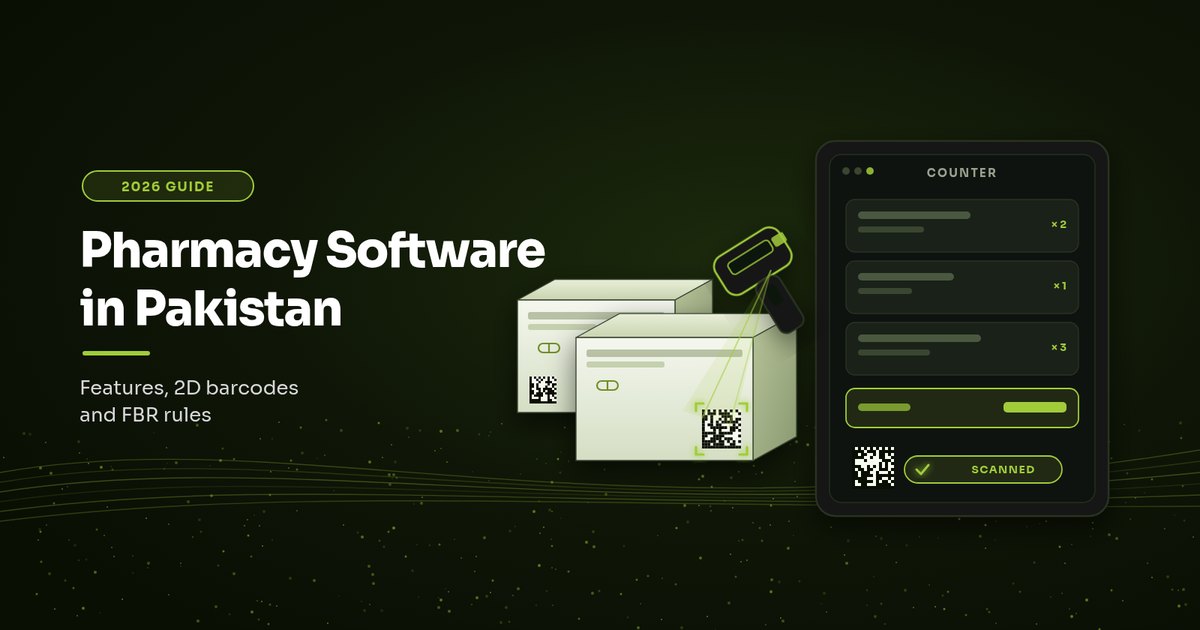
A medical store in Pakistan juggles thousands of items, each arriving in batches with their own expiry dates, prices and supplier bonuses. A paper register or a generic billing program can only go so far. In 2026 two more things have changed the picture: medicine packs now carry 2D barcodes under DRAP’s track and trace system, and FBR has redrawn the line for which retailers must connect their counters to its system.
This guide explains what pharmacy software actually does, the features that matter for a Pakistani pharmacy, and how the DRAP and FBR rules affect it.
What is a pharmacy management system?
A pharmacy management system is software that runs the day-to-day work of a pharmacy or medical store in one place: buying stock from distributors, keeping track of every batch and its expiry, billing customers at the counter, handling returns, and reporting on sales and stock. Larger setups add multiple branches, a central warehouse, accounts and a mobile app for the owner.
At its core it answers three questions at any moment: what is on the shelf, when does it expire, and what has been sold.
Core features a Pakistani pharmacy needs
Batch and expiry tracking
The same medicine reaches a pharmacy in different batches, each with its own expiry date and sometimes a different price. Good software records the batch and expiry on every purchase and links each sale to a batch. It can then sell the batch that expires first (often called FEFO, first expiry, first out) and warn staff before a near-expiry item goes over the counter.
Near-expiry alerts and returns
Expired stock is lost money. The system should list items expiring in the coming weeks so the pharmacy can sell them, move them to another branch, or return them to the distributor under the agreed policy. Expiry returns, replacements and supplier claims should be tracked rather than kept in a separate notebook.
Box, strip and tablet units
Pharmacies buy by the box and often sell by the strip or tablet. The software has to convert between these units automatically, so the stock count stays right when a customer buys two strips from a box of ten.
Salt (generic) search
When a brand is out of stock, staff often look for an alternative with the same salt or formula. Linking each product to its generic name lets the counter find substitutes in seconds. The final choice still belongs with the pharmacist and the prescriber.
Purchases, bonuses and distributor accounts
Distributor bills come with discounts, bonus quantities and credit terms. The software should record these properly so the true cost of each item is known, and so payables to each distributor are always up to date.
Fast counter billing, even offline
The counter is where queues form. Billing should work from a barcode scan or a quick search, print a clear receipt, and keep working when the internet drops, syncing once the connection is back.
User roles and audit trail
The owner, pharmacist and counter staff need different permissions. Price changes, discounts, deleted bills and stock adjustments should be logged with the user and time, which protects the business as much as it controls staff.
Reports that help decisions
Useful reports include daily sales, profit by item and category, slow-moving and dead stock, near-expiry stock, distributor-wise purchases and branch comparisons. For a chain, a central dashboard or owner app shows all branches together.
How DRAP’s 2D barcodes affect pharmacy software
Since 9 October 2026, registered medicines made in or imported into Pakistan must carry a GS1 DataMatrix 2D barcode with a unique serial number, as Phase 1 of DRAP’s Pharmaceutical Track and Trace System. Packs made or imported before that date are exempt and can still be sold. We covered the full rollout in our guide to the DRAP track and trace system.
For retailers, DRAP’s guidelines (section 14.2) say distributors, wholesalers and retailers shall register with DRAP and acquire GLNs (global location numbers), deploy and maintain systems that can scan barcode data and interface with DRAP as required, and report suspect products to DRAP. DRAP has not published a separate timeline for retail scanning, so watch for further circulars.
In practical terms, this means pharmacy software should be able to:
- read a DataMatrix code with a 2D scanner (older laser scanners only read ordinary 1D barcodes);
- pick up the product code, batch, expiry and serial number from a single scan instead of typing them;
- handle old packs without the code and new packs with it on the same shelf for months;
- keep the serial and batch data in a form that can be shared with DRAP when that connection is required.
Does a pharmacy need FBR POS integration?
Only if it is a Tier-1 retailer. FBR’s POS integration FAQ says integration is mandatory for all Tier-1 retailers “irrespective of the items they are dealing in”, so pharmacies are not exempt as a category.
The Finance Act 2026 changed who counts as Tier-1. According to FBR’s Circular No. 01 of 2026, the card-payment test has been removed, so accepting cards or digital payments alone no longer makes a shop Tier-1. A new test covers retailers with declared turnover above Rs 200 million, or turnover worked back from withholding tax under sections 236G and 236H above that figure, and a wholesaler-cum-retailer is now Tier-1 only above the same Rs 200 million turnover. The definition still includes units of national or international chains, shops in air-conditioned malls or plazas, and retailers whose electricity bills over the previous 12 months exceed Rs 1.2 million.
If a pharmacy is Tier-1, its billing software must report every sale to FBR in real time and print FBR’s invoice number and QR code on the receipt. Integration runs through an FBR-licensed integrator, and FBR states that PRAL acts as a licensed integrator and provides integration free of cost on demand. Whether your pharmacy is Tier-1 is a tax question, so confirm it with your tax adviser. The software side is simpler if FBR integration can be switched on per branch when needed.
Ready-made or custom pharmacy software?
A single medical store with a standard workflow can often start with packaged software. Custom software starts to make sense when a business has needs a generic product handles poorly, for example:
- a chain with a central warehouse, inter-branch transfers and a single view of stock;
- a pharmacy attached to a clinic that needs to link prescriptions and billing;
- a distributor that also runs retail counters;
- an owner who wants a mobile app for live sales, stock and expiry alerts;
- a business that needs to connect pharmacy data with its own accounts or ERP and POS system.
Whichever route you take, make sure the data stays yours: you should be able to export stock, sales and supplier records at any time.
Frequently asked questions
What is a pharmacy management system?
It is software that manages a pharmacy’s purchases, batch and expiry tracking, counter billing, returns, stock and reports in one place, often across several branches.
Which software is used in a medical store?
Most medical stores use pharmacy POS or pharmacy management software that combines billing with batch and expiry stock control. Bigger chains add accounts, multi-branch stock and an owner app, sometimes through a custom system.
What are the main features of pharmacy management software?
Batch and expiry tracking, near-expiry alerts, box, strip and tablet units, salt search, distributor purchases and returns, fast offline billing, user roles, reports and, now, 2D barcode scanning.
Do pharmacies in Pakistan have to scan DRAP 2D barcodes?
DRAP’s guidelines say retailers shall deploy systems that can scan the barcode data and interface with DRAP as required. No separate retail deadline has been announced, so a 2D-capable setup is a sensible step now.
Is FBR POS integration mandatory for pharmacies?
Only for pharmacies that are Tier-1 retailers, such as chain units, mall shops, those with electricity bills above Rs 1.2 million in 12 months, or turnover above Rs 200 million. Check your status with a tax adviser.
If you are planning pharmacy software or a pharmacy mobile app, you can talk to our team.
Planning a software project?
Tell us what you want to build and our team will suggest the right web, mobile, ERP or AI solution.