Software
National Data Governance Policy 2026 for Software Teams
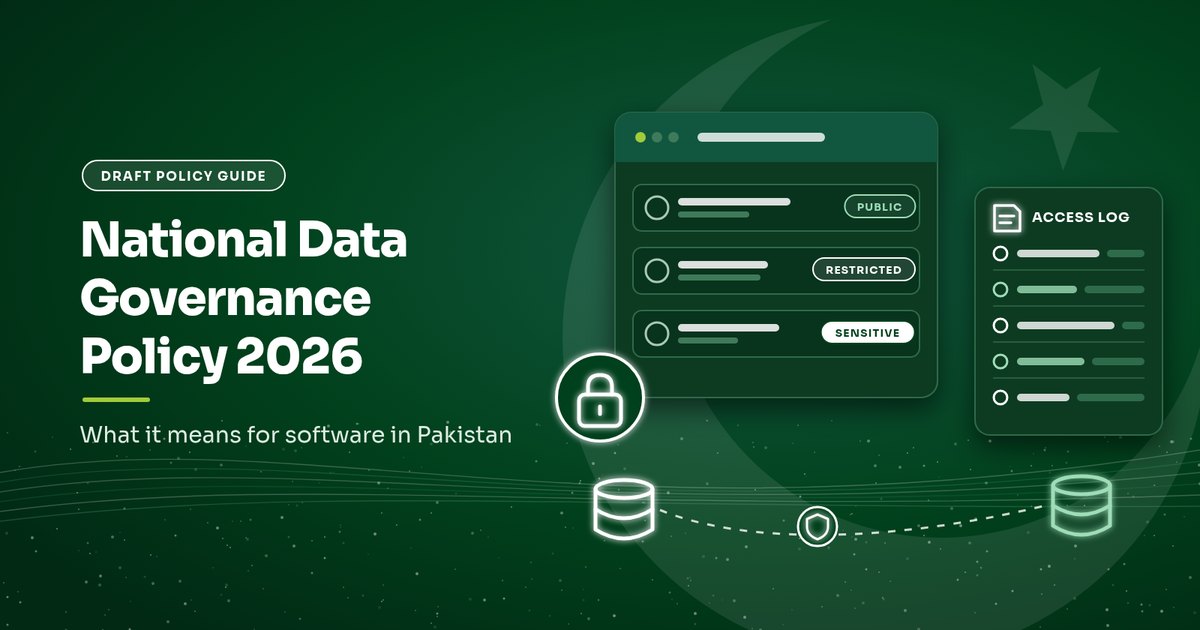
In June 2026 the Ministry of Information Technology and Telecommunication (MoITT) released the draft National Data Governance Policy 2026 for public comment. It declares government data “a strategic national asset” held in trust for citizens (Dawn, 30 Jun 2026). Most of the discussion so far has been about rights and institutions. This article looks at a more practical question: what the policy means for the software that collects, stores and shares government data.
Where the policy stands
Public comments closed on 10 July (Dawn, 30 Jun 2026). On 5 August the Federal IT Minister chaired a consultation with federal and provincial bodies, and the Pakistan Digital Authority (PDA) said it would review their proposals before finalising the policy, which will include a phased implementation plan (APP, 5 Aug 2026).
The policy takes effect after federal cabinet approval and notification in the official Gazette. Detailed timelines will come in a forthcoming National Data Strategy (Business Recorder, 29 Jun 2026). As of 27 October 2026 we could not find a public report that it has been notified. Even so, the minister described it at an international summit on 21 October as the single national framework for classifying, sharing, protecting and publishing public data (APP, 21 Oct 2026). The direction is clear, so it makes sense to understand it now.
Who it applies to
The framework covers federal ministries, divisions, departments, attached departments, statutory corporations, regulators, authorities and public-sector companies. It also covers contractors, processors, concessionaires, grantees and partners that process government data on the federal government’s behalf. Provinces are encouraged to adopt it or develop equivalent frameworks (Dawn, 30 Jun 2026).
That second group matters for software. Much government software is built, hosted or run by outside teams. As one technology lawyer put it, for many technology companies compliance “begins with revised procurement requirements and contractual terms” (Dawn, 7 Aug 2026). Existing contracts involving government data must be updated within twelve months of the policy taking effect (Business Recorder).
The policy does not cover personal data held outside the public sector (Dawn, 30 Jun 2026). A private school or shop managing its own customer records is not its direct target.
What the policy asks of software systems
The reported provisions read like a set of system requirements. Here are the main ones and what they mean in practice.
Access logs citizens can rely on
Citizens get the right to know who within government accessed their personal data, when and for what purpose (Dawn, 30 Jun 2026). A system can only honour that if it records every read, not just every edit, along with the user and a stated reason. As the Dawn op-ed notes, this makes audit trails “more than good internal practice” (Dawn, 7 Aug 2026). Logs also need protecting so they cannot be quietly changed.
Data export in machine-readable formats
Citizens can obtain their data in a structured, commonly used, machine-readable format and have it sent directly between public bodies where feasible (Dawn, 30 Jun 2026). Public-sector data is to be open by default on the National Open Data Portal, with metadata, unless classification or law restricts it. Systems need clean export functions and well-described data, not just screens and printed reports.
Classification, encryption and hosting in Pakistan
Sensitive personal data gets stricter access controls, mandatory encryption, shorter retention periods and enhanced audit requirements (Dawn, 30 Jun 2026). Sensitive government and personal data will generally have to be hosted and processed within Pakistan, and offshore processing needs prior approval (Business Recorder). So every data field needs a sensitivity label, with role-based access, encryption and retention rules that follow from it, and hosting has to be chosen with location in mind.
Consent that can be seen and withdrawn
Where consent is the legal basis, it must be granular (Business Recorder). The minister described consent as “visible and withdrawable” (APP, 21 Oct 2026). In a web or mobile app, that means separate consent options rather than one tick box, a record of what each user agreed to, and a working way to withdraw.
Children’s data and privacy by design
Children’s data gets age-appropriate notices, limits on profiling and behavioural advertising, and parental or guardian involvement where required (Dawn, 30 Jun 2026). High-risk processing needs a Privacy Impact Assessment, and public bodies must adopt privacy-enhancing technologies under a “Privacy by Design” instrument (Business Recorder; Dawn). In short, privacy is considered at the design stage, not added after launch.
Breach reporting
Public bodies must notify PDA without undue delay after a personal data breach, and tell affected citizens where the risk to them is high (Dawn, 30 Jun 2026). Contractors are expected to notify PDA promptly after qualifying incidents (Dawn, 7 Aug 2026). Software needs monitoring and alerts that can spot a breach and show what was affected.
One source of truth and the WASL exchange
The policy bars public bodies from keeping multiple copies of citizens’ personal data. They are to rely on designated “Primary Data Registers” and exchange data through a national exchange called WASL. It also adopts the “once-only principle”: citizens should not have to give the same information to different agencies again and again (Business Recorder).
PDA’s chairman said the policy does not centralise all government data on one platform. Ownership stays with each institution, and WASL enables secure exchange based on data classification (APP, 5 Aug 2026). Through WASL, every transaction is to be authenticated, encrypted and logged, with citizen consent built into the exchange (APP, 21 Oct 2026).
For developers, this points towards API-based integration in place of spreadsheet imports and duplicated databases. Systems will need to call an authoritative register, handle consent and access errors properly, and log each exchange.
AI used in government decisions
Agencies using AI for legally significant decisions must ensure explainability, continuous monitoring, meaningful human oversight and public transparency. Automated decision-making systems are to be listed in a public registry kept by PDA, and generative AI use comes with safeguards against factual errors, intellectual property violations and data leakage (Business Recorder). The minister summed up the principle: AI should support human decision-making, not independently decide anyone’s rights or entitlements (APP, 21 Oct 2026).
For an AI system, this means keeping the reasons behind each output, routing decisions to a human reviewer, and keeping personal data out of places it should not go.
FAQ
What is the National Data Governance Policy 2026?
It is MoITT’s framework for how federal public-sector data is collected, stored, shared, published and disposed of, with PDA as the authority responsible for it under the Digital Nation Pakistan Act, 2025 (Dawn, 30 Jun 2026).
Is the draft National Data Governance Policy 2026 in force?
Not yet, as far as we could find. It takes effect after cabinet approval and Gazette notification (Business Recorder).
Is there any data protection law in Pakistan?
Not a comprehensive one yet. The Personal Data Protection Bill has been in draft form since 2018 (Dawn, 7 Aug 2026). The policy is to be updated once such a law is enacted (Dawn, 30 Jun 2026).
What is an audit trail in software?
It is a protected record of who did what in a system and when. Under this policy it must also show who accessed a citizen’s data and why (Dawn, 30 Jun 2026).
Building for what comes next
The policy shows where government software in Pakistan is heading: classified data, logged access, consent records, machine-readable exports, hosting in Pakistan and governed exchange. Building these into web apps, mobile apps and AI solutions from the start is easier than adding them once a system is live.
If you are planning a system that will handle government data, get in touch.
Sources
- Dawn, 30 June 2026, “IT ministry unveils draft data governance policy”: https://www.dawn.com/news/2011804
- Business Recorder, 29 June 2026, “Pakistan unveils National Data Governance Policy 2026 to transform digital governance”: https://www.brecorder.com/news/40427660
- APP, 5 August 2026, “Shaza chairs high-level consultation on National Data Governance Policy 2026”: https://www.app.com.pk/national/shaza-chairs-high-level-consultation-on-national-data-governance-policy-2026/
- Dawn, 7 August 2026, “Pakistan’s privacy debate”: https://www.dawn.com/news/2021159
- APP, 21 October 2026, “Pakistan building digital infrastructure to support inclusive, trusted AI services: Shaza Fatima”: https://www.app.com.pk/national/pakistan-building-digital-infrastructure-to-support-inclusive-trusted-ai-services-shaza-fatima/
Related posts

Planning a software project?
Tell us what your school or business needs and our team will suggest the right web, mobile, ERP or AI solution.
Talk to our teamRelated: Web App Development AI Solutions Custom Software Development Software House Islamabad & Rawalpindi Software House Peshawar